
Death or Glory by Sandy Mitchell
I couldn’t help myself. It was already in my Audible library, I didn’t have a lot of brain power to read actual books (currently on my third heavy cold for the season), and I really wanted to try and wipe the disappointment from The Traitor’s Hand away.
Death or Glory goes further back in Commissar Ciaphas Cain’s career, back to when he earned a major boon for his reputation as a hero (despite trying to do anything but). His regiment of Valhallan Imperial Guard troops gets deployed Ork world only to be attacked in transit, and through luck (and a strong desire to be anywhere but in the line of fire), he ends up on an escape pod with his trusty aide, Jurgen.
Together they end up separated from their regiment and the fleet, crashing into the planet where they spend the book trying to get back to the safety of their own lines with the aim of doing so in the easiest way possible. Course, it being a Cain book, that ends up attracting as much attention as possible and ends with him killing the biggest Ork Warboss in the sector in a single combat.
This one was definitely better than The Traitor’s Hand. Still not as good as books one or two, but much more enjoyable to read. To start with, it was funnier hearing him recount the tales of the earlier version of him; not quite Cain the Hero of the Imperium yet, but still doing everything in his power to look impressive whilst trying to avoid getting shot at. Not quite a rookie Commissar, he’s still trying to find his sure footing in his role and authority, for example trying to deal with his suspicious company commander, or the rather too enthusiastic engineseer his finds planet side. Having to use his charisma and political skills to try and unite a mistrustful and stubborn local forces, whilst also integrating rescued civilians and emaciated refugees makes for a much more interesting read that inter-regimental politics and waiting.
Death or Glory also benefited from constant, clear and present danger. From having to try to authenticate himself amongst the local forces whilst also uniting them under a common purpose (i.e. keep him alive) without having to overuse his authority (i.e. shoot people till he gets his way), to keeping a convoy of looted vehicles going across desert, hoping that the hidden supply dumps are both fully stocked and not under Ork threat.
Plus, Mitchell just seems to write Orks better than Chaos. I think Chaos is a difficult enemy to write in this kind of setting; unlike the more serious Gaunt’s Ghosts anthology or any of the Inquisitor novels, there’s more of an expectation of humour in the Cain series. Like I said before, the end scene of Traitor’s Hand was great; the confrontation with a resurrected daemon from Cain’s past, and his subsequent victory was a major payoff.
Similarly, Chaos was the big bad in the first book, but the majority of it was detective work, the introduction of Inquisitor Amberley Veil (who continues to be a highlight of the audiobooks, acting as the editorial notes), and the inter-species diplomacy between the Imperium and the T’au Empire who both lay claim to that world.
Orks don’t require sub-plots or subterfuge, and they don’t require build up to a big bad. They’re comically brutal and huge monsters, and the big bad is just a bigger and badder one. They’re dangerous enough to be taken seriously, but thick enough to be taken at face value. Exactly what’s needed.
I’ll be taking a break from the series for now, but at least my faith has been restored.
7/10
Bad Reviews
Writing on the internet isn’t a new experience for me. I’ve had Bear blogs, Wordpress blogs, think I’ve had one or two Blogspots in the past. Most of those though were by me, for me, with no-one else working on them or editing them. All except for one.
I don’t remember the site name, we’re talking easily ten years ago now, but I do remember what it was. A review site I got introduced to through a friend, who also wrote for it. Every month I’d get a handful of DVDs - movies, TV shows, even WWE once or twice. There was no word limit, just a style guide and a deadline for each one. Some of it was fairly average, including an Alan Moore thing I barely remember except for a line or two. Some of it was really really good, and some of it was really, really bad. That‘s the bit that sticks with me the most.
There’s a scene in the Sorkin drama Newsroom where the guy who runs the digital news desk came back from being on the run after feeling the state to protect a source to find everything he’d worked for trashed by some dude who’d rather fill it with badly written listicles like ‘the most overrated movies of all time’ and fill it with the Matrix and Avatar. It’s great scene; Neal dresses him down thoroughly and calmly, before leading the way forward. Peak Sorkin, I watch it probably once a month on YouTube.
And then I realised I was that dude, and I relished in it. When I got the chance to write a bad review, I went full steam into it. There was one in particular, some little indie movie that I hated every second off. Typical British late night BBC3 style crap geared towards a certain crowd. I think I spent three or four hours making sure I could be as savage as I could be. It was the only that ever got heavily edited before it went live.
I don’t necessarily regret writing a bad review, and I wasn’t consistently as savage. There were movies that were just boring - I didn’t particularly enjoy Ben Stiller’s Walter Mitty for example, except for the last scene with Sean Penn. I also made a point to not just judge it on the movie. I’d look up what trivia I could find, any interviews, background on the cast and director etc.
What I do regret was being bad at it. I gave into tired edginess and let it sway me into just being downright terrible. I was a CinemaSins loving, mid-20s cynical sarcastic git, and I was more than happy to let that shine on the page while I ripped apart someone else’s work. What’s worse, I proud to do so.
As I write my reviews here, it’s something I’m trying to bear in mind. Smart Notes in particular was tough. Like I said in my opening sentence, I was all geared up to be harsh, which is fine if it’s deserved but not if I’m just doing it to feel good. It took me a good while to write, and few edits and proofreads to check over, just to make sure I was being fair and balanced and not giving into my worst impulses. Interestingly, I also ended up scoring it higher as a result, and was left wondering how many of my earlier scores could have benefitted from the same treatment. Would I have been so direct and brutal? Could I not have found something?
I’ve learned a lot from writing bad reviews badly, and hopefully I keep that lesson in the front of my mind.
The Traitor's Hand by Sandy Mitchell
One of the things I’ve been indulging in this year is rekindling my love for Warhammer 40,000 novels. I used to be into the hobby back in my teens, but found the books easier to get in to. Mostly because money, but also because I suck at painting.
Outside of the Gaunt’s Ghost and Inquisitor novels, one of the most recommended series is the Ciaphas Cain novels, following one of the most vaunted Heroes of the Imperium who gets his reputation despite doing his hardest to stay out of harms ways as much as possible.
The first two books in the series, For The Emperor and Caves of Ice, were fantastic. Another two that were wildly helped with being audiobooks, with different cast members performing the footnotes and passages from other perspectives, both got a 9 out of 10 from me over the summer.
Which adds to my disappointment with Traitor’s Hand, because it just didn’t capture me in the same way.
To be perfectly fair, it could be the time of year. Winter has a significant affect on me, and I may just be hampered by my mood shifting and attention drifting. That said, there are a number of things that stand out.
For The Emperor had a degree of intrigue and mystery amidst the combat and politics. Plus it had the Tau (an enemy by way of being alien rather than being ‘evil’) and introduced Inquisitor Amberley Vail, both as a character and love interest for Cain. Caves of Ice had oodles of tension and drama, involving Orks and the deadly Necrons (Warhammer’s version of the Terminator), plus solid action scenes.
Traitor’s Hand seemed to include the same qualities, just not as much. The bad guys were Chaos, but the kind of Chaos that regular strength Imperial Guard can handle (the Guard are regular soldiers versus the superhuman Space Marines), and you don’t really see much of their activities. There’s killing and human sacrifices sure, but you don’t really see it so much as be told it had happened and the characters see the aftermath.
There was some mystery, sure. Cain and his retinue had to figure out where the final ritual site was going to be before it could be finished, but you didn’t really see that through the novel but towards the last act. Most of the combat was kind of forgettable, and the secondary antagonistic, a rival and lesser Commissar called Beige (which fits both as a character description and as meta criticism) had his moments but I never really believed he was going to do anything of consequence.
There is some redemption; the climactic scene between Cain and the daemon that got summoned, and the build up towards it. Cain as a character is also enjoyable, his status as a reluctant hero, more interested in self-preservation and keeping the appearance of being a great and active hero than in being one is fun to read (or listen to), whilst also being balanced out by his occasionally heroic and incredibly capable actions. Plus the Amberley interludes where she provides wider background knowledge to Cain’s POV narration is a highlight of the audiobooks.
I just wish the rest of the book was better. Still, on to the next one.
6/10
Evolving a poem
I wasn’t going to share this for two reasons. First, I don’t feel like it’s anywhere close to done. It’s not even a v1.0 in my mind, it needs a fair amount of work. Including on a title.
But more importantly, I’m not overly convinced I hit what I was trying to say. More on that later though, because both are irrelevant. I have a post quota to hit, and I need to get in the habit of sharing and not hiding, so here we are.
More and more I find I Spend my days Inventing ways To go back to when I had More to say. Before my days were copy/paste, Blankly staring into space On a screen, avoiding my dreams. Where I had passion running through my veins Before I voluntarily put on the chains of Responsibility. Spending my days Arguing over addresses and names, Filling out forms to fill out more. Select/copy/paste. Select/copy/paste. Click. Click. Click. Click. Click. Nine to five, Mon to Fri, So I can live without feeling alive. It wasn’t always so, But that was a lifetime ago And yet. And yet. A man can dream.
It started as a lot of my work does in the past. I feel a feeling, I get a snippet, and that snippet sits and waits for me to be ready to expand on it. In this case, it was lines 1-5: More and more I find I Spend my days Inventing ways To go back to when I had More to say.
Yes, I’m pretty sure this was a Monday morning. Job satisfaction is pretty low at the minute/month/year, and I’m pretty prone to the old Remember When: when you were younger and freer, didn’t feel so trapped in work, were more active in various areas etc.
Lines 6 and 7 followed on quite quickly before I put the notecard down: Before my days were copy/paste, Blankly staring into space
I liked the idea that copy/paste meant two things to me; that my days are often repetitive unless I put the effort in to adjust, and that my days are literally copy/pasting information from one place to another, and then another, and then another…
I’m less convinced by lines 8-13: On a screen, avoiding my dreams. Where I had passion running through my veins Before I voluntarily put on the chains of Responsibility. Spending my days Arguing over addresses and names, Filling out forms to fill out more.
I often find that the way forward creatively is to take a feeling, twist, and exaggerate to get more interesting language, but in this case it feels too far if only because it feels resentful of my role in life. The chains of Responsibility are real; a husband, dog owner, mortgage payer, future family man, all of which need paying for so I sit at my job that bores the skin off me because taking a risk elsewhere jeopardises all of the above. But I’m not resentful of that, because the rewards are obvious and plenty. I have a wonderful wife, a great dog (but needs more training), a house and a salary. I resent the boredom, and not the responsibility, and so it just feels hollow and fake. Not what I’m trying to convey at all.
I have a similar problem with the last 5 lines: It wasn’t always so, But that was a lifetime ago And yet. And yet. A man can dream.
It’s weak sauce. How my head feels like a poem should end, rather than words I believe in.
The repetitive section though and the two lines after hits something for me, so an initial rewrite would start at least at: More and more I find I Spend my days Inventing ways To go back to when I had More to say. Before my days were select/copy/paste, Select/copy/paste. Click. Click. Click. Click. Click. Nine to five, Mon to Fri, So I can live without feeling alive.
Not sure that’s totally complete, but it’s already miles better.
Just needs a name.
Desk job?
November Review
Month 3! Let’s check how I’ve been doing.
Quick refresher: the aim of the blog is to make me publicly accountable for actually progressing in my hobbies, alongside using Beeminder to fine me if I miss the goal. The three I’m currently tracking and their monthly targets are:
- Reading: Finish one book per month
- Writing: Write four posts here per month covering one of the activities (500 word minimum)
- Pool/snooker - play/practice five times a month
✅ Reading
Another two books finished - The Remains of the Day by Kazuo Ishiguro, and Dungeon Crawler Carl by Matt Dinniman. Reviews listed below. I now have two books currently on the go:
- Four Hour Work Week by Tim Ferriss on Kindle
- Kafka on the Shore by Haruki Murakami
- The Traitor’s Hand by Sandy Mitchell on Audible The Kindle has not seen a lot of love this month. I’ve had a lot on personally, and I think I’m just struggling a bit with taking the subject matter seriously. That said, I want it finished by end of year, so I’ll need to crack on.
This is my second attempt on Kafka on the Shore. First time I just found it too weird, especially when it starts raining fish…Again, I want this done by end of year. Do not like having books on my did not finish list.
The Traitor’s Hand I’ve been looking forward to for a while. The Ciaphas Cain series has been a god send this year. I’m already best part of 2 hours deep on it.
✅ Writing
4 posts for the month, 1 a week:
- Turns out Gamification Works
- Explanations, not Excuses
- The Remains of the Day by Kazuo Ishiguro
- Dungeon Crawler Karl by Matt Dinniman
✅ Pool/Snooker
Managed five sessions despite being sick for a couple of weeks. Included play pool against one friend (and winning) and snooker against another (and losing).
Beeminder
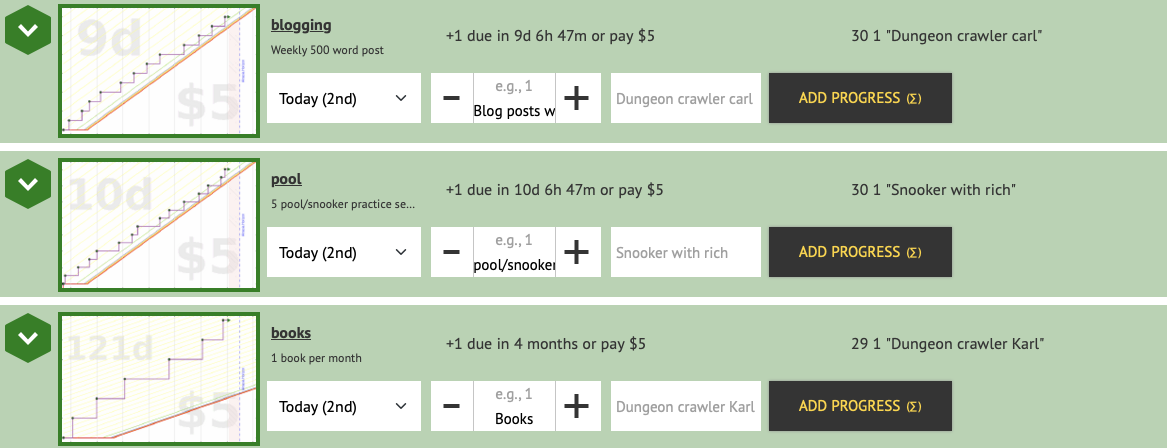
Quarterly Check In
This completes the first quarter of the project, and I’m left in 2 minds.
Part of me is disappointed. It feels like to a certain extent I’m coasting, especially on my writing, where it just feels hollow, like I’m pushing out words to hit a target. My pool and snooker playing could also be more efficient towards improving, as opposed to just playing.
On the other hand, I’m undeniably hitting my targets and making progress. I’m especially happy with my reading progress. I’ve achieved a consistent rate I’ve not had in years, almost entirely because I’ve had this blog to write for and Beeminder on my mind. If I keep this up, I’ll have read more books in 2025 than I have any other year, and next year it’ll be well into the 20s.
There’s also the reality of what I’m doing, which is an angle I’ve always struggled with: the work is the point. It’s ok if it’s hollow, it’s ok if it’s not ‘efficient’. The work is the point. The showing up is the point. Eventually work becomes good work, and occasionally great work.
So I’m going to stay the course target wise. I do want to put in a practice routine for both pool and snooker, to help direct my skills a little, but otherwise I’m going to stay the course another three months. If I keep my reading levels up though, I’ll be increasing it next quarter.
Dungeon Crawler Carl by Matt Dinniman
This one was a friend recommendation, and is another Audible listen. It’s also my first real dip into the realm of LitRPG, so I wasn’t entirely sure what to expect but what I got was an easy and fun listen.
It’s also really hard for me to describe because it’s kinda out there, so I’m gonna cheat a little and steal the blurb:
You know what’s worse than breaking up with your girlfriend? Being stuck with her prize-winning show cat. And you know what’s worse than that? An alien invasion, the destruction of all man-made structures on Earth, and the systematic exploitation of all the survivors for a sadistic, intergalactic game show. That’s what.
Join Coast Guard vet Carl and his ex-girlfriend’s cat, Princess Donut, as they try to survive the end of the world—or just get to the next level—in a video game-like, trap-filled fantasy dungeon. A dungeon that’s actually the set of a reality television show with countless viewers across the galaxy. Exploding goblins. Magical potions. Deadly, drug-dealing llamas. This ain’t your ordinary game show.
See what I mean?
A bit like with Isaacson’s Leonardo Da Vinci, I do think this benefitted greatly from me listening to it vs how it would have been to read. Jeff Hays did an outstanding job on the voice acting, really nailing the voices for Carl and Donut, and really elevating the story from ‘meh, ok?’ to ‘solid and steady’. Dungeons and Dragons but for realisies and for the entertainment of aliens like it’s the Hunger Games isn’t particularly complicated, and unless you’re super into RPGs could be a bit of a slog.
The voice acting also lifted the more gamey aspects, like the achievement notification voice overs Carl would get after killing a boss for the first time, or when he’s being trolled by the AI running the dungeon for heading into it without any weapons or suppliers (or trousers). Plus, with the book being in first person, there was that extra dimension to it; being told it by the ‘character’, getting a voice to the story.
If it had been paperback, I could see myself getting a little too eye roley at the memes. There’s the AI’s foot fetish, for example, or the neighbourhood boss, the KraKaren: part Kraken, part Karen. The llama like creatures being meth addicts, is another. I just don’t think it’d play as well without the VA also playing the exasperated human to it.
That said, there’s still a lot to like. I got sucked in pretty hard to the journey, to Carl and Donut’s relationship growing (thanks to a transformation biscuit giving Donut the ability to talk very early on) and to the minor twist at the end. I won’t be rushing into book 2 any time soon (I’ve already started book 3 of the Ciaphas Cain series) but I’ll definitely be returning next year, or whenever I next get a discount to sign up for Audible again.
Or who knows? Maybe I’ll give the paper book a go, especially now I have a voice for the characters in my head.
7/10
The Remains of the Day by Kazuo Ishiguro
This is one that took a while for me to be convinced by. For the better part of 80 pages I was telling others that it was reading like Mr Carson from Downton Abbey was taking a road trip across 1950s Britain with the Lord’s car to meet up with Mrs Hughes. Pleasant and easy reading, but not exactly enthralling.
Then the hints of a plot start dripping through. Flashbacks to conversations, arguments, a budding romantic connection between Carson and Hughes (well, actually Mr Stevens and Miss Kenton, but once the reference point came to mind in the first few pages I never shook it), and of course the attempts to rationalise and excuse the growing Nazi sympathies of the employer, Lord Darlington. If When We Were Orphans, another lauded work of Ishiguro’s I read this year, was eccentric and alive, The Remains of the Day was exploration of British restraint and dignity.
And what an exploration it was. Told entirely in first person, we see the conflicts in Stevens’ mind, with his quest to embody the sense of dignity he so admires and emulate the highly regarded butlers of his time constantly at odds with his humanity and his employer. It does the job of both showing and telling perfectly, giving his blinded perspective of highly charged emotional events, displaying the physical effects and the lack of understanding. In particular, his manner around his dying elderly father, slowly passing away whilst Stevens has tasks to do and the drip feeding of the emotional effects on the body.
But self-awareness and self-doubt does start to creep in. In the latter half of the book, having spent a few days travelling and reflecting, he starts to re-read the letter from Miss Kenton that started the whole trip off in the first place, considering whether she was quite so keen to move back to work and away from her husband after all. He starts to reflect on his playing the part of Peter to Lord Darlington’s Jesus, denying his existence to guests of his new employer and new owner of the mansion, or the severity of his Nazi ideology and associations with Herr Ribbentrop.
The scene that epitomises this is the flashback of a conversation between Stevens and Lord Darlington’s godson, who turned up during a pivotal meeting between Lord Darlington, the British PM, and Ribbentrop. The godson almost pleadingly trying to get Stevens to admit he’s on his side, that he can see Darlington be misled, played with as a useful pawn in British society, and Stevens feeling the tinge of regret at playing the loyally blind servant to his faithful and beyond reproach employer.
When We Were Orphans got a 7.5 from me in my reading log. It was an enthralling read, again exploring the theme of a blinded man pursuing his ideals, but whiffed the ending in my mind. This wasn’t that; it didn’t capture your mind through action and adventure, but through quiet reflection and exploration of duty and dignity, in a similar sense to the theme of what it means to be a gentleman in Great Expectation. Not my favourite book of the year, but still good enough to get an 8/10 for me.
Finished The Remains of the Day yesterday. Full review coming, but free to love it. Still preferred When We Were Orphans, though both are opposites. Trying Kafka on the Shore for the second time. Couldn’t get on with the weirdness on my first go years back now, let’s see if it’s any easier now.
Explanations, not excuses
So after talking a good game on how gamification seems to really be working last week, I’m on track to be missing my weekly pool session.
Normally, this is where I’d spiral in a fit of shame fuelled anger. The usual recriminations: I’m weak, pathetic, how hard is it to do 1 thing, etc. But this year it’s catching me a little different because of phrase I’ve had bouncing around my skull.
Explanations, not excuses.
I often find that as a society we tend to label reasons why we, or others, either don’t do something or don’t meet the mark in someway as an excuse. Excuses are inherently negative; even when we tell ourselves or whoever is the excuse giver that it’s a good excuse, we’re still often implying they’re trying to worm their way out of their commitment and into forgiveness.
We can sometimes do the same for other people, like a parent trying to excuse their child’s behaviour. Always it’s the same; excuse the negative, hope for the positive.
This creates a pretty heavy burden on me when it comes to my own shortcomings. My perfectionism has set a pretty high bar for expected behaviours and outcomes, so excuses come loudly and often to an unforgiving mind. Follow that up with the self-awareness to know what I’m doing on all sides of the debate and I usually just end up doing nothing as a result to avoid the shame.
Until I started reframing it.
If excuses are emotionally charged attempts to avoid consequences and achieve forgiveness, explanations are cold logical attempts to gain understanding, which helps you gain a measure of peace. An explanation for something helps you see the why behind a thing without their being an expectation of judgement. You’re just stating facts after all.
Explanations aren’t consistently perfect; there are bad, or more accurately, lazy, explanations just as there are bad excuses. A lazy explanation is hand waving, surface level thinking. A good explanation then has logic at it’s core and in ‘if this then that’ premise. ‘This happened because that happened causing this.’ Since I’ve started having that phrase beat against the edges of my skull, dealing with incidents and failures have been significantly easier.
So what’s my issue and explanation this week? It’s looking increasingly likely that I’m going to miss my pool/snooker obligations this week. It’s due by Tuesday but various reasons have kept me away from the table.
First, I’m sick. I have a heavy cold that started being symptomatic Monday, progressed to the peak on Wednesday/Thursday, and am now feeling a bit more alive whilst also expelling all of the hard gunk. Not ideal playing fitness.
Second, I had a 3 hour neurodiversity assessment on Friday, something I’ve been dreading for a while, largely because it was a 3 hour appointment talking about my entire life to a new psychiatrist (unsurprisingly, the results were yes, you’re on the spectrum). This also meant I could risk sneaking off the to the local cafe and their terrible table to play pool in case I was late for the appointment.
And yet I’m still gonna try. Now I’m over the worst, and fuelled by a ginger powered concoction, I’m seeing a friend later who needs some support. I’m meeting him down the pub, which I hope has a pool table, but if not I know there’s a table nearby. I’m sure I’ll find my way to it somehow.
But if not, I’m fairly safe in the knowledge that I’ve had some fairly solid reasons this week, and I can go on regardless.
Turns out gamification works
I’ve had a really long week. Between work taking it out of me, deadlines for various appointments and meetings creeping up on me (and in once, dumping 8 forms that needs completing immediately in my lap), and dealing with the aftermath of a very highly stimulating and intense saturday, I’ve not had a lot of energy spare for anything else.
Plus the attempts I did have at playing pool were scuppered. My lunch break game on Tuesday had to be called off to help with stuff at home, and on Friday the second worst pool table I’ve ever played on was actually occupied by someone else that day, which is the last time I go there on a ‘normal’ lunch time.
So late on Friday night, I was considering the possibility of skipping this weeks post and practice session. A week wouldn’t hurt, certainly not on blog posts where I’ve built up a small buffer, although granted not as big as reading double the target. Plus it’s not like I don’t have legitimate reasons to skip a week. Then I checked Beeminder and changed my plans.
Sure, with blogging I had a 1 week grace period, but if I didn’t play snooker or pool by Tuesday, I’d be penalised. Now, the penalty would be $5, so around £4, and no matter how I looked at it it would cost me more to play for an hour that it would to skip.
That thought lasted about 30 seconds, and I booked an hour and a half to happen after my gym session. I even cut my session short despite trying to make my health a priority right now to ensure I got the most of my session. II was not skipping it, not this week, not while I had a hard deadline.
This isn’t my first dalliance with gamification. I’ve done the whole ‘Don’t skip days’ thing with a calendar and pen to cross out each day I’ve done a thing. I’ve tried literal gamification, using the app Habitica. I’ve tried various habit trackers, including using the ones in my mood tracking app Daylio until that got too much. All of them didn’t last longer than a few weeks, and ended up making me resent the activities in question.
Especially Habitica. No matter how hard I tried, I just could not get on board with that.
Each of them failed because it felt too much to track a daily or weekly activity that way, but they also failed because there was zero penalty for failure outside of feeling bad, and I can handle feeling bad.
I purposely set the penalty low at $5 initially because I didn’t want to fall into the trap of failing, paying a stupidly price, and then scrapping it all in a tantrum. But the idea of being hit by $5 still stings. That’s a day’s commute to the office, or the extra treats for my wife I buy. Now I’m back into, that’s half my monthly sub to WoW Classic, and if I keep the failure going it doubles. It’s affordable, but it’s enough of a sting that I paid nearly triple to get a decent session today.
So turns out gamification works on me after all, I just needed the right incentive at the right dose. And I can play catch up at the gym tomorrow, safely in the knowledge that I’ve hit my goal for the week.
Finally picked up WoW Classic after years of thinking about it and an hour and a half spent watching playthroughs yesterday. Sometimes the algorithm’s good.
October Review
Month 2! Let’s check how I’ve been doing.
Quick refresher: the aim of the blog is to make me publicly accountable for actually progressing in my hobbies, alongside using Beeminder to fine me if I miss the goal. The three I’m currently tracking and their monthly targets are:
- Reading: Finish one book per month
- Writing: Write four posts here per month covering one of the activities (500 word minimum)
- Pool/snooker - play/practice five times a month
✅ Reading
Another two books finished - Leonardo Da Vinci by Walter Isaacson, and The Muscle Ladder by Jeff Nippard. Reviews listed below. I now have two books currently on the go:
- Four Hour Work Week by Tim Ferriss on Kindle
- The Remains of the Day by Kazuo Ishiguro The Remains of the Day is proving to be difficult. A really rough description of it is it’s kinda of like Mr Carson from Downton Abbey goes on a road trip across the 1950’s midlands, drip feeding you plot points through memories. I’m halfway through, and it’s starting to pick up, so fingers cross. Outside of starting a new audiobook, I’m going to focus my reading time on these two as much as I can. Really want to get them both finished this month.
✅ Writing
Posts 3 and 4 were trickier for me. I let the deadlines do their job though and a pass is a pass. 5 posts for the month, 1 a week:
✅ Pool/Snooker
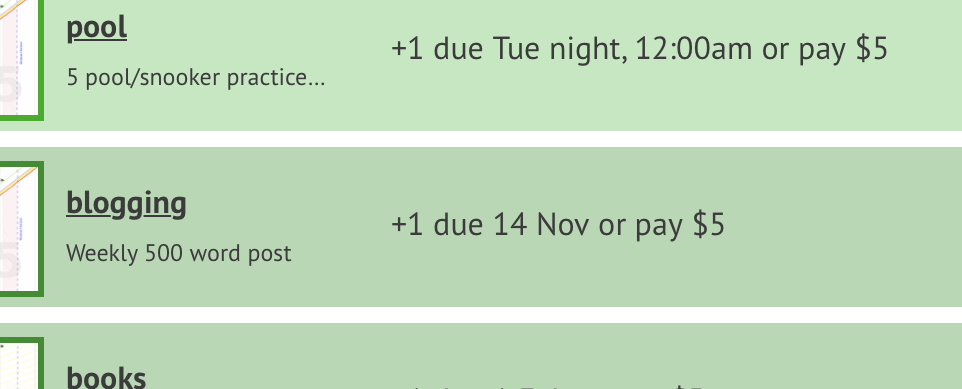
Managed five sessions. The last two weren’t great, and I do need to come up with a good way to structure a practice. Snooker in particular has a greater time need; 1 hour around the table just isn’t enough to get any real progress. Either way though, still counts.
Beeminder
I just held in my hands a second edition copy of the each book in the Lord of the Rings in near immaculate condition. I have literal goosebumps.
Leonardo Da Vinci by Walter Isaacson
Note: this review is for the Audible version read by Alfred Molina. While that doesn’t necessarily affect the content, there is obviously a different experience between listening to a wonderful voice through your headphones and reading 624 pages. Long either way, but still a different experience.
I’ve mentioned before that this one has been on my read list for about 8 years now. I got it after listening to the Steve Jobs biography, also by Isaacson, having been taken with the writing style and thinking that biographies might be for me after all. I think I lasted about half an hour before realising that it probably wasn’t smart to follow a 27 hour audiobook with a 17 hour one; burn out is real.
I’m glad I didn’t return it though, because it’s easily one of the best books I’ve read for a while. It’s by no means an academic level historical review of his life; at several points Isaacson will discuss various theories about a painting or a relationship before offering his own non-expert opinion, so if you’re looking for a definitive article, this ain’t it.
What it is though is a fascinating view of the life and work of one of history’s most famous polymaths. It follows his life from being raised as an illegitimate son of a notary and his apprenticeship under Verrocchio, to his various times spent in Florence, Milan, Rome, and ultimately France. Along the way, Isaacson covers notes and background on his most prominent works, culminating in the seminal Mona Lisa, but also the various works and commissions he started but failed to complete.
The latter point if part of what really interested me along the way though: the way Da Vinci worked. Isaacson regularly reviews and quotes from the many, many notebooks Da Vinci left behind, covering his famous to-do lists, to observations he made of nature and anatomy and how he applied them to his art (like noting how the muscles of the face worked and applied to facial expressions), to the personal notes he left, including arguments with his young apprentice/partner, Salai.
He doesn’t just talk about genius, but of Da Vinci’s inherent curiosity he held towards all things and his pursuit of that knowledge, however controversial or heretical it may have been at the time. Rather than being fully irreverent to his legendary status, Isaacson humanises Da Vinci, pointing out his distracted nature, more inclined to procrastination and flights of fancy than intense focus. From dropped projects, to enquiries leading to nowhere, to even his eventual disinterest in the thing he’s most famous for, his paintings, compared to his quest for the answers to the universe, all in the aim of slaking his curiosity.
Again, if you want an academic text on the life and work of Leonardo Da Vinci, it probably shouldn’t surprise you that a New York Times bestseller isn’t for you. As a pop-history book though, I highly recommend it. For me personally, it’s really helped reinforce something I’ve been trying to convince myself of for some time: to actually engage in my curiosity, to try and learn and widen the scope of my knowledge, rather than convince myself that it’s pointless, or I won’t have time.
So on a personal level, 10/10.
I have not put as much time into reading as I’d have liked this month, but I’m determined to finish a second book before Friday. Just a few hours will do the trick.
Every time I cook a roast, I plan it all in advance. Chicken cook time, veg prep time, all of it. And every time, without fail, I forget to account for parboiling the potatoes, adding an extra half hour or so. So, so frustrating.
Poetry
I rarely ever listen to or pay any real attention to lyrics in songs, not consciously at least. I’ll find myself singing them later, so at least some part of my brain does, but in the moment I’m focusing on how they fit into the song. The melody, the rhythm, the harmonies behind it, the place each have in the mix. One big soundscape.
It’s why I listen to a fair amount of non-English language songs, largely J-rock or J-pop, with a smattering of other European countries. On the other hand, it’s also why I’ve long struggled to write lyrics to any songs I’ve written. I can hear the cadence in my head, beat it out on the desk, but any time I put pen to paper it just feels hollow. Devoid of meaning, just words for the sake of words.
On the other side, there was poetry. That I could do.
One of the reasons I keep some kind of notebook with me at all times is I’ll get just snippets pop up in my head. Two or three lines of rhymes or feelings, a snippet of dialogue, a direction in which to go. Every now and then I’d review them, see which ones still have a place in my brain, and try and flesh it out.
And I was kind of okay at it. Put some online, got some praise. In particular a war one I wrote around Remembrance Day that I can neither find nor remember. I’d do open mic nights locally and not totally bomb, which is a solid minimum result. Then I just kind of stopped.
One of the things I’ve been trying to do a lot more recently is avoid over intellectualising things; change course from treating everything like it’s a deep intellectual puzzle that needs analysis and just see if the surface diagnosis fits. In this case, it is that simple: the open mic night closed, so I fell out of that routine, depression and neurodivergence did their work on distracting me from it, and I never allowed myself to go deep in process. It didn’t worm its way into my core.
And I was alone. Not truly, I had friends, I have family, but on this I was alone. I had no friends trying to do the same thing, no mentor I could learn from, and I didn’t have the social skills to try and make one. I was ‘on the breadline’ poor, so taking classes was out of the question, and while there were libraries and books, I had no idea what I was looking for, especially as I was so wrapped up in my perfectionist ‘I can do all the things if I try’ mindset.
But times change and so do I. I may not be surrounded still by poets and artists, but I can change that, even if it’s digital interactions over physical in the short term. I can lean back into my curiosity, expand myself out there again. I’ve got my Zettelkasten ready to accept snippets to flick through, and collect snippets from poetry that resonates with me. And I’ve got a much better selection of research tools than I did 15 years ago, not to mention a much better understanding of my self, how I tick, and how to get around my shortcomings.
I need to finish the three books I currently have on the go, but after that, I’ll be buying/adding A Poetry Handbook by Mary Oliver and How to Write One Song by Jeff Tweedy as a starting point. Then we’ll go from there.
Skill Gap
The thing about being a relatively busy adult with a load of responsibilities whilst dealing with neurodiversity issues is that it’s really easy to lose sight of the fun and creative hobbies you want to do. This then leads to the skills behind these hobbies atrophying, creating the dreaded skill gap - the distance between what you can do, and what you want to do.
I feel this most with my guitar playing. I’ve been playing on and off for nearly 20 years, but I would say my skills are trapped in that state of high beginner. Theoretically, I can hang at an intermediate level. Modes, positions, fingerboard awareness, extended chords and how to use them. All in my brain ready to use. I just can’t back it up.
I can definitely play, and play rhythm fairly fast and accurate; I can follow along at around 160bpm, and I can sort of solo. Improvisation is an area I often fail in outside of a pure flow state, usually because all I can hear in my head when I’m trying to solo over a backing track is the original solo (or a live recorded version).
Then there’s the fiddly bits. My bends aren’t 100% accurate and I struggle to put vibrato on them. I can hammer on/pull off pretty cleanly up to about 100bpm in quarter notes, but not much further or faster, and not for more than say 4 to 6 bars. Slides often get a bit blurry if I try to apply speed so the target note gets lost. Then there’s the speed picking issue, plus the fact that I struggle above the 15th fret in any position really.
Combine that with the tendency to play unplugged and I’m left with the inability to turn the sounds in my head into reality.
There are other hobbies I’ve let atrophy, or ones that I want to start picking up, that are similarly easy enough to assess the skills gap. The one I struggle with though is writing. How do you assess something essentially subjective? There’s no real 16th note alternate picking or speed legato playing equivalent in the art of writing, outside of perhaps grammar, and even then, there’s ways around it. Hello, Claude.
Experience has told me that unless it’s universally disliked, writing is difficult to qualify. Low effort, badly written books can still pick up a fan base, whilst highly rated best sellers still have their detractors. For example, I’ve personally tried and failed to read One Hundred Years of Solitude 3 times; I just can’t get on board with it. See also: Rivals by Jilly Cooper, a book that seemed more interested in introducing the 6 page glossary of characters than writing about any of the things said characters actually do on the daily, other than cheat on their partners.
ChatGPT (whose grammar opinions I trust less than Claude, for reasons, although I find it better for general purpose use) tells me to try and assess things like storytelling and structure, narrative pacing, scene construction, but again, being a relative novice at this how would I know? Then there’s the directions I want to push into more - poetry, story writing, etc.
Of course, the answer is simple: I find out by doing the thing. Start writing poetry. Start writing more fiction. Make it more of a daily habit. Then assess it. Pick up things I struggle with, just like I notice the struggle adding vibrato to a string bend.
More importantly, stop using the unknown or unknowable as a reason to not do the thing, or even learn more about doing the thing.
My pencils are sharp enough.
Not overly impressed with the new Tame Impala album on the first go. A few tracks stood out, but it kind just melded into one after a while. Definitely has a vibe, will need to give it a re-listen.